Far infrared heating is often mentioned in connection with heated clothing, warming pads and other products designed to provide comfortable warmth. But what does the term actually mean, and how does it relate to graphene heating films?
Far infrared heating is a form of thermal radiation. In an electrically powered heating product, electrical energy is converted into heat, and the warm surface releases part of that energy as infrared radiation. The technology behind a practical heating product is less mysterious than it may sound.
For manufacturers, the important questions are how the heating element works, how evenly it distributes heat, and how it performs inside the finished product.
What Is Far Infrared Heating?
Infrared radiation is part of the electromagnetic spectrum, just beyond visible red light. We cannot see it with our eyes, but we encounter infrared radiation every day from the sun, warm objects and heating equipment.
Far infrared refers to the longer-wavelength portion of this spectrum. According to the International Commission on Non-Ionizing Radiation Protection (ICNIRP), far infrared, also called IR-C, covers wavelengths from approximately 3 micrometers to 1 millimeter.
When infrared radiation reaches a surface and is absorbed, its energy contributes to heating that surface. This is one of the ways a warm heating element transfers energy to its surroundings.
It is worth remembering that far infrared is not a separate source of energy. In an electric heating film, the energy comes from electricity. Infrared radiation is one of the ways the resulting heat is transferred.
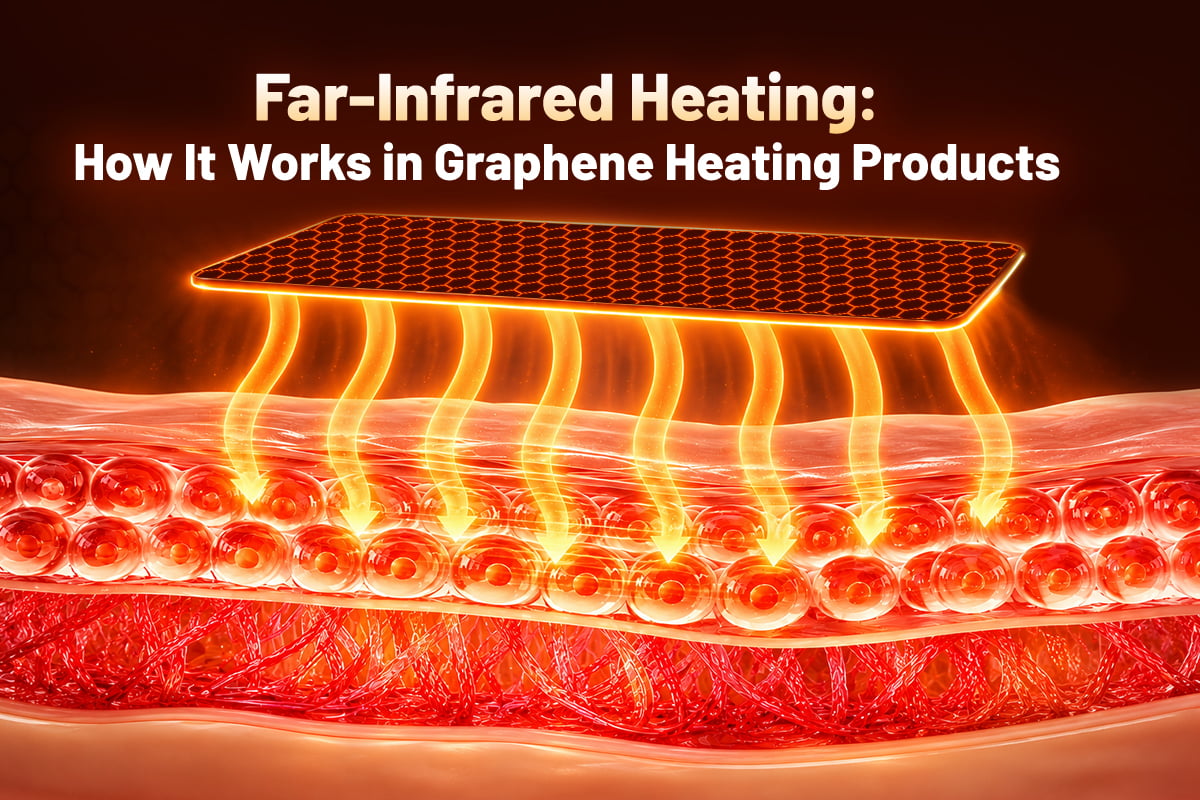
How Does Far Infrared Heating Work in an Electric Heating Film?
An electric heating film contains a conductive heating layer connected to a power supply. When current passes through the material, electrical resistance causes energy to be converted into heat. This process is known as Joule heating.
As the film warms up, it transfers heat through a combination of conduction, convection and thermal radiation. The relative contribution of each depends on the product structure, surface temperature, surrounding materials and operating conditions.
For example, a heating film placed inside a cushion transfers much of its heat through the fabric and padding. A warm surface exposed to the air also emits infrared radiation. Both forms of heat transfer can be involved in the same product.
This is why the complete product design matters as much as the heating material itself.
What Role Does Graphene Play?
Graphene is a carbon material known for its electrical and thermal properties. Graphene-based conductive materials can be incorporated into flexible heating films to create thin heating elements for different applications.
When designed with suitable electrodes, insulation and electrical controls, these films can provide controlled heating while remaining relatively thin and flexible.
A 2011 research paper published in Small, by researchers at Nankai University, examined flexible graphene-based electrothermal films. The researchers evaluated how the films performed under different voltages, including heating speed and temperature response.
Further research published in Nanoscale investigated a flexible graphene heater designed to work in different shapes, including tests involving repeated folding.
These studies show why graphene-based materials are of interest for flexible electric heating. However, the use of graphene does not automatically mean that a heating product is more efficient, emits more useful far infrared radiation or performs better than every conventional heating element. Those differences need to be supported by testing under comparable conditions.
For a product developer, the value of a graphene heating film lies in how well its material properties fit the required design.
Where Are Far Infrared and Graphene Heating Films Used?
Flexible electric heating elements can be used in many products where space, weight and comfort are important.
Heated Clothing and Wearable Products
Heated jackets, vests, gloves and other wearable products need heating elements that can fit into fabric structures without making the finished product unnecessarily bulky.
The heating film must also work with the garment’s power supply, temperature settings and expected movement during use.
Heating Pads and Home Textiles
Electric heating pads, heated cushions, blankets and similar products use flexible heating elements to provide warmth over selected areas.
In these applications, the material above the heating film, temperature distribution and control system all influence the user’s experience.
Personal Warming Products
Heated eye masks, waist belts, knee pads and other personal warming products may use thin electric heating elements together with fabric, padding or adjustable supports.
The goal is to deliver controlled warmth in a compact structure. The appropriate temperature, heating area and operating time depend on the product’s intended use.
Other Product Applications
Flexible heating films can also be considered for selected automotive components, anti-fogging applications and custom temperature-control products.
These applications have different technical requirements, so a film suitable for a heated textile may not be appropriate for an automotive or industrial device without further evaluation.
For examples of different heating-film structures and product applications, see PMA’s graphene heating films and heating solutions.
What Should Manufacturers Check Before Choosing a Heating Film?
When selecting a heating film for a new product, the first step is to define the operating conditions rather than focus only on the material name.
Several details deserve attention:
- Operating voltage and power: The heating film must match the available power supply and the product’s electrical design.
- Temperature distribution: The heating area should warm as intended without creating unacceptable hot spots.
- Flexibility and dimensions: The film must fit the product and withstand the expected bending or movement.
- Insulation and temperature control: Electrical protection, sensors and controls need to be considered as part of the complete heating system.
- Durability: Repeated operation, bending, moisture exposure and other expected use conditions should be evaluated where relevant.
For products marketed specifically for far infrared performance, manufacturers should also consider whether suitable spectral emission measurements are available. A claim about a particular infrared wavelength range should be based on testing, not simply on the presence of graphene.
These checks help determine whether a heating film can be used reliably in a finished product.
Does Far Infrared Heating Have Special Health Benefits?
Far infrared radiation has been studied for a range of biological and medical applications. Researchers have examined how infrared exposure interacts with the skin and how controlled heating may affect the body.
A scientific review titled Far Infrared Radiation (FIR): Its Biological Effects and Medical Applications, available through PubMed Central, discusses laboratory findings and possible medical uses of far infrared radiation.
However, results from specific medical studies should not be treated as proof that ordinary heated clothing or consumer warming products provide the same effects.
Claims about detoxification, disease treatment or other medical benefits require evidence for the particular device and its intended use. A graphene heating film by itself is not evidence of a medical effect.
For consumer heating products, the more useful starting point is whether the product delivers comfortable, controllable warmth and meets the relevant safety requirements.
Graphene Heating Film Development at PMA
At PMA, we develop and manufacture graphene heating films and related heating products for a range of applications, including heated textiles, wearable products and customized heating systems.
Our work covers heating-film production, electrical integration and finished-product manufacturing. Different products require different film dimensions, electrical specifications, control methods and material structures.
For customers developing a new heating product, we normally begin with the application itself: where the heating element will be installed, what temperature is needed, how it will be powered and what conditions it must withstand.
More information about our development and production processes is available on the PMA manufacturing capabilities page.
If you are planning a new product or looking for a flexible heating-film supplier, contact PMA with your target heating area, voltage, temperature range and basic product requirements.